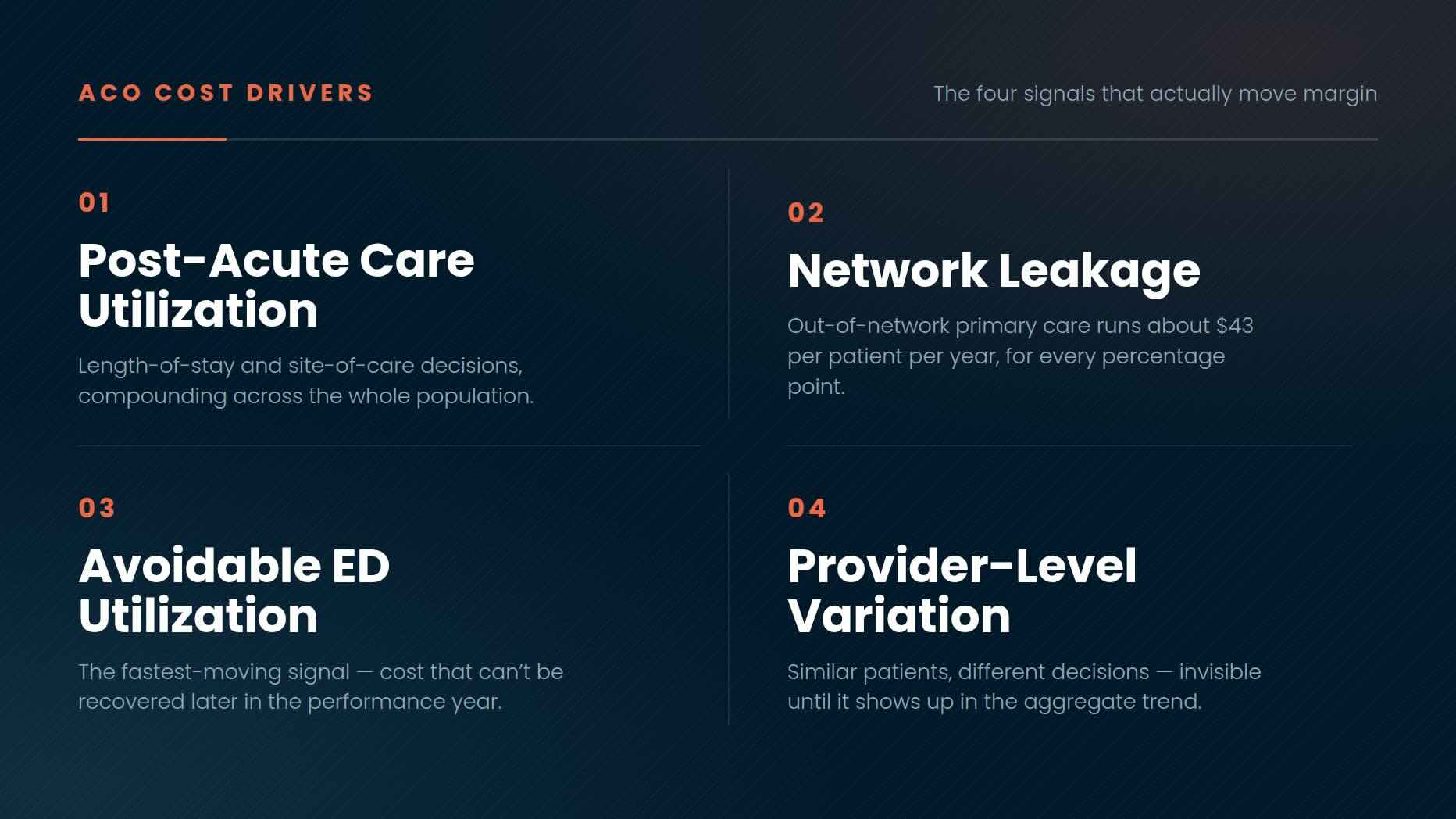
Reducing Network Leakage Improves ACO Financial and Quality Outcomes

Performance Results
Accountable Care Organizations (ACOs) spend enormous energy on care management, quality improvement, contract performance, and financial modeling. But there’s a lever that quietly affects all of those areas—and too often gets overlooked until it becomes a problem: network utilization.
Put simply: Network utilization is the percentage of care that happens inside your ACO’s preferred network. Network leakage is everything that slips outside of it.
And leakage is far more common—and far more costly—than most organizations realize.
In an analysis of a Medicare Shared Savings Program (MSSP) ACO:
- 32.9% of total expenditures were paid to out-of-ACO providers
- 89.8% of beneficiaries received some out-of-ACO care
These findings have significant implications: when nearly a third of all cost of care falls outside the ACO, cost control and shared savings become much harder.
But most ACOs have invested heavily in reducing post-acute care leakage, tracking skilled nursing facility utilization and home health patterns with increasing sophistication. Yet they're missing critical opportunities that exist much earlier in the patient journey—in primary care and preventive services. This is where the real leverage lies for both quality outcomes and financial performance.
Network utilization deserves a seat at the executive table because it delivers value across both value-based and fee-for-service business models simultaneously. Few other ACO initiatives can make that claim.
How Network Optimization Drives Both Value-Based and FFS Revenue
Every ACO operates in two worlds simultaneously, and network utilization is one of the rare strategies that advances both.
From the Value-Based Care Perspective:
When services stay in-network, you maintain control over both the cost and quality of care delivery. You can identify and address wasteful utilization patterns—such as unnecessary advanced imaging or duplicative testing. You have direct accountability for the services delivered within your network, which becomes the foundation for success in risk-bearing agreements. Without this visibility and control, managing total cost of care becomes nearly impossible.
The Fee-for-Service Reality:
Despite the shift toward value-based payment models, fee-for-service revenue still keeps the lights on for most healthcare organizations. In-network services generate the revenue that funds operations, pays staff, and supports infrastructure investments. CFOs need to see both sides of the financial equation, and network utilization helps both priorities instead of creating tension between them.
The challenge is significant. Research shows that leakage rates for specialists remain around 66.7% despite network design efforts, while primary care physician leakage averages 8%. These numbers reveal substantial room for improvement across the care continuum.
Unlike many initiatives that force leaders to choose between value-based and fee-for-service priorities, network optimization is one of the rare strategies that advances both simultaneously. When you keep a patient's primary care visit in-network, you protect fee-for-service revenue while also maintaining the relationship continuity essential for value-based success.
Why Primary Care Leakage Threatens Your ACO Attribution
While post-acute care may involve higher dollar amounts per episode, primary care services hold the key to your ACO's long-term viability. The reason comes down to one critical factor: attribution.
The Attribution Factor:
Medicare attributes beneficiaries to ACOs based on plurality of primary care services. A beneficiary is assigned to the ACO where they receive the greatest proportion of primary care services, measured in terms of allowed charges. This isn't a minor technical detail—it's the mechanism that determines your entire attributed population.
Beginning in 2025, CMS expanded attribution methodology to include beneficiaries who receive primary care from nurse practitioners, physician assistants, and clinical nurse specialists. This change is estimated to add over 760,000 beneficiaries to ACO attribution nationwide, making the importance of capturing all primary care touchpoints even more critical.
The attribution process follows a specific methodology. First, CMS looks at whether the beneficiary received the plurality of primary care from your ACO's primary care physicians—those in internal medicine, general practice, family practice, or geriatric medicine. If the beneficiary had no primary care physician visits during the performance year, attribution then looks at plurality of care from nurse practitioners, clinical nurse specialists, and physician assistants.
This attribution is retrospective, finalized at the end of each performance year. The majority of patients are assigned through primary care physicians, with the remainder coming through the nurse practitioner and physician assistant pathway.
The Triple Threat of Out-of-Network Primary Care:
Every primary care visit that goes out of network creates three distinct problems:
- Lost Revenue: The fee-for-service income flows to a competitor instead of supporting your operations.
- Lost Control: You can't ensure that quality measures are closed, preventive screenings are completed, or HCC documentation is captured accurately. These touchpoints directly impact your performance scores and risk-adjusted benchmarks.
- Lost Attribution: If the patient receives more primary care services from another provider or ACO during the performance year, they may be assigned to that organization next year. You lose not just one visit, but potentially the entire relationship.
The Low-Hanging Fruit:
The most actionable opportunities often involve routine services that patients might receive anywhere:
- Annual wellness visits
- Preventive care screenings
- Basic evaluation and management encounters
- Chronic disease follow-ups
Why This Matters More Than High-Dollar Post-Acute Care:
Post-acute care certainly involves significant expenses per episode. But primary care services represent:
- The foundation of your patient relationships
- The gateway to all other services in the care continuum
- The key to attribution that determines your population
- The opportunity for quality gap closure and HCC documentation that impacts benchmarks
The fragility of attribution relationships cannot be overstated. The question isn't just whether you're providing good care—it's whether you're the primary care provider for your attributed population.
The Hidden Costs of Network Leakage
The scale of the problem extends well beyond what appears on financial statements. Health systems with 100 affiliated providers experience $78 million to $97 million in annual losses from referral leakage alone. More than 40% of healthcare organizations lose over 10% of annual revenues to various forms of leakage, while 19% lose over 20%. Perhaps most concerning, 23% of organizations don't even know how much they're losing.
Imaging Overutilization:
When patients receive care from multiple unconnected providers, wasteful patterns emerge. Duplicate advanced imaging—MRIs, CT scans, and other expensive diagnostics—occurs because providers don't share results effectively. This creates both higher costs and potential health risks from unnecessary radiation exposure. You lose the ability to track and manage appropriate utilization across your population.
Readmissions from Poor Coordination:
Out-of-network care breaks the care coordination chain at its weakest link. When a patient is discharged from a skilled nursing facility you don't partner with, or sees a specialist who doesn't communicate back to the primary care team, preventable readmissions occur. You have no visibility into why these readmissions are happening, which means you can't implement improvement strategies for care you don't control.
The Opportunity Cost:
Every out-of-network touchpoint represents a missed chance for comprehensive care. That visit could have included:
- Depression screening using validated instruments
- Diabetes management and medication optimization
- Blood pressure monitoring and intervention
- Mammography or colorectal cancer screening scheduling
- HCC documentation for accurate risk assessment
- Other evidence-based preventive care measures
HCC Documentation Impact:
CMS uses Hierarchical Condition Category (HCC) risk scores to adjust ACO benchmarks. Accurate HCC coding directly impacts your financial benchmark—higher risk scores result in higher benchmarks, which allows for appropriate compensation when caring for complex patient populations. When patients receive care out of network, you lose the opportunity to document their conditions comprehensively, potentially leaving your benchmark artificially low relative to your population's true complexity.
The One-Touch-Per-Year Problem:
For relatively healthy patients, you may only have one annual visit to accomplish preventive care goals. If that visit happens out of network and the receiving provider doesn't perform comprehensive preventive services, you've lost your only opportunity for that entire year. The patient returns next year with gaps in care that could have been addressed, and your quality scores reflect those missed opportunities.
What ACOs Can Actually Control About Patient Leakage
"We can't control patient behavior" remains the most common pushback against network utilization initiatives. While there's truth to this concern, it reveals an incomplete picture of the actual dynamics at play. Poor referral data isn’t just a clinical problem. It’s a leak in your revenue cycle, attribution, and benchmark.
The Reality Check:
Research shows that between 25% and 50% of referring physicians don't even know whether their patients consulted the recommended specialist. This isn't primarily about patient behavior—it's about system design and communication.
Communication Gaps:
Before patient referral visits, 68% of specialists reported receiving no preliminary information about the case. Furthermore, 70% of specialists rate the quality of referral information they do receive as fair or poor. These gaps create confusion, duplicated work, and missed opportunities for coordinated care.
The Two Levers You DO Control:
While you cannot dictate patient choices, you have substantial influence over two critical factors:
1. Referral Patterns:
Ensuring your providers refer to in-network specialists represents your most direct lever. Research reveals a striking disconnect: 79% of healthcare providers believe in-network care coordination is important, yet 8 in 10 refer patients out of network. Nearly 20 million clinically inappropriate referrals occur each year, largely due to lack of information about specialists and their capabilities.
The problem isn't that providers actively prefer out-of-network referrals—it's that they fall into patterns of convenience and familiarity. They refer to the same specialists they've always used, regardless of network status or whether better options have become available.
2. Patient Education:
Patients often go out of network simply because they don't know about in-network alternatives or don't understand the implications. You can influence this through:
- Educational materials showing convenient in-network locations
- Cost comparison information demonstrating potential savings
- Mail campaigns and office handouts at every encounter
- Clear communication about quality and coordination benefits
The Gap in Tracking:
Many ACOs lack the tools and processes to effectively monitor referral patterns. Only 47% of healthcare executives say they understand patient leakage moderately well, and just one-third manage leakage very or extremely well. This represents both a challenge and an opportunity—organizations that develop robust tracking capabilities gain significant competitive advantage.
6 Proven Strategies for Network Optimization
The stakes for getting this right are substantial. Only 54% of faxed referrals become scheduled appointments, and 63% of patients with inappropriate referrals require re-referral. This inefficiency results in $1.9 billion wasted annually on lost wages and unnecessary co-pays across the healthcare system.
1. Start with Data and Visibility
You cannot improve what you don't measure. Begin by:
- Identifying where leakage is occurring by service line
- Separating expected leakage (services you don't offer) from unexpected leakage (services you do offer)
- Focusing initial efforts on services you have strong in-network capacity to deliver
- Building dashboards that make leakage patterns visible to leadership
Remember that 23% of organizations don't monitor or report on patient leakage at all. Simply achieving visibility puts you ahead of nearly a quarter of your peers.
2. Define Your Complete Network
Create a clear taxonomy of your network that includes:
- Traditional in-network employed and contracted providers
- Preferred partnerships representing your expanded network
- Clear documentation of which services should reasonably stay in-network
- Geographic considerations that may necessitate some out-of-network care
3. Prioritize Your Focus Areas
Not all leakage carries equal strategic importance. Structure your priorities as follows:
High Priority:
- Primary care services (attribution risk is paramount—remember that 81% to 82% of attribution comes through primary care)
- Preventive care services (quality measures and HCC documentation opportunities)
- Services where you have strong, convenient in-network capacity
Medium Priority:
- Specialty services with good in-network options
- Advanced imaging services
- Post-acute care with established partnerships
Lower Priority (but continue monitoring):
- Services not available in your network
- Expected geographic leakage where patients live far from your facilities
- Highly specialized services requiring tertiary care centers
4. Engage Your Providers
Physician engagement determines whether network utilization initiatives succeed or fail. Strategies include:
- Sharing network utilization scorecards that show individual and group performance
- Educating providers on attribution rules and their financial impact on the organization
- Making in-network referrals as easy as possible through EHR integration and referral tools
- Providing current, accessible lists of in-network specialists with their credentials and areas of expertise
The gap here is significant: 91% of providers believe access to specialty information is important, yet 72% refer to the same providers by habit regardless of network status or clinical appropriateness.
5. Educate Your Patients
Patients need information to make informed choices:
- Develop patient-friendly materials showing convenient in-network options
- Highlight potential cost savings (patient retention is 6 to 7 times less costly than acquiring new patients)
- Explain quality and coordination benefits of staying in-network
- Make this information available at every touchpoint—scheduling, check-in, discharge, and follow-up
6. Measure and Monitor
Establish ongoing tracking that includes:
- Utilization rates by service type and individual provider
- Trend monitoring over time to identify improvement or deterioration
- Celebration of improvements to reinforce positive changes
- Quarterly strategy adjustments based on data insights
Partner Networks and Strategic ACO Relationships
Not all "out-of-network" utilization is created equal. Some services will always go outside your traditional network by definition:
- Dialysis centers you don't own, but your patients require
- Specialty facilities in other health systems with unique capabilities
- Home health agencies covering geographic areas you don't serve
- Durable medical equipment suppliers
Creating Strategic Partnerships:
Rather than treating all external utilization as problematic, sophisticated ACOs take a different approach:
- Identify high-quality out-of-network providers your patients already use frequently
- Establish formal partnership or preferred provider agreements
- Treat these relationships as an "extended network" for monitoring purposes
- Negotiate preferred rates and care coordination protocols
- Share data and quality metrics when possible
Three-Tier Monitoring Approach:
The most sophisticated ACOs track utilization across three categories:
- True in-network utilization (employed and contracted providers)
- Partner/extended network utilization (formal relationships with coordination protocols)
- Complete out-of-network utilization (no relationship or coordination)
This approach helps differentiate between acceptable leakage (high-quality partners meeting patient needs) and problematic leakage (fragmented care with coordination gaps).
How to Present Network Optimization ROI to Leadership
Different stakeholders respond to different aspects of the network utilization value proposition. Tailor your message accordingly:
For the CFO:
"Patient leakage costs our organization $821,000 to $971,000 per physician annually. Every primary care visit we keep in-network protects both our fee-for-service revenue AND our ability to earn shared savings in our value-based contracts. This isn't an either/or proposition—it's one of the rare initiatives that advances both business models simultaneously."
For Clinical Leadership:
"Network utilization gives us the control we need to ensure patients follow our clinical pathways and receive evidence-based care. When 70% of specialists rate the referral information they receive as fair or poor, keeping care in-network ensures continuity and prevents the care fragmentation that leads to poor outcomes and readmissions."
For the Board:
"Eighty-seven percent of hospital executives prioritize reducing patient leakage, but only one-third manage it effectively. With 10% to 30% of our revenue at stake and attribution rules depending on primary care plurality, network optimization is both a defensive strategy protecting our current business and an offensive strategy enabling our value-based future."
Key Metrics to Track:
Establish a dashboard that includes:
- Percent of primary care services delivered in-network
- Percent of specialty care delivered in-network
- Attribution rate and trends over time
- Network leakage by service line with trending
- Cost per member per month comparison: in-network versus out-of-network
- Quality measure closure rates by network status
- HCC recapture rates
Network utilization often lives in the shadow of flashier ACO initiatives like care management, post-acute care programs, or digital health innovations. But as ACOs mature and move toward greater financial risk, the ability to keep care in-network becomes fundamental to success—perhaps even more important than the higher-profile initiatives.
Across our ACO clients, we see the same pattern: primary care leakage is the earliest warning sign of attribution loss—but it’s also the easiest to correct. The real power of network optimization lies in its dual benefit: it simultaneously improves your value-based care performance while protecting the fee-for-service revenue that still funds most operations. Few other initiatives can make that claim. You don't have to choose between today's business model and tomorrow's—network utilization advances both.
Start with the low-hanging fruit: primary care and preventive services. Effective network optimization also requires real-time referral visibility, attribution risk tracking, and leakage monitoring. Koan Health’s analytics platform supports ACOs in identifying these patterns and acting quickly.
If you want to understand your network leakage in real numbers, Koan Health can map it for you—service line by service line, provider by provider, and dollar by dollar.”
Frequently Asked Questions
How common is out-of-network care in ACOs?
In a study of a Medicare Shared Savings Program ACO, 32.9% of total expenditures were paid to out-of-ACO providers, and 89.8% of beneficiaries had some out-of-ACO expenditures. NIH
How common is out-of-network care in ACOs?
In a study of a Medicare Shared Savings Program ACO, 32.9% of total expenditures were paid to out-of-ACO providers, and 89.8% of beneficiaries had some out-of-ACO expenditures. NIH
Does out-of-network primary care really increase costs or reduce quality?
Yes— one large analysis found that higher out-of-network primary care correlates with higher per-beneficiary spending and lower rates of preventive care measures (e.g., diabetic retinal screening, HbA1c tests, LDL cholesterol screening). HealthAffairs
Does out-of-network primary care really increase costs or reduce quality?
Yes— one large analysis found that higher out-of-network primary care correlates with higher per-beneficiary spending and lower rates of preventive care measures (e.g., diabetic retinal screening, HbA1c tests, LDL cholesterol screening). HealthAffairs
Are there proven strategies for designing lower-leakage networks?
Yes — research on “low-leakage, patient-centric provider networks” shows it’s possible to build network structures informed by patient behaviors and natural community patterns, reducing leakage while preserving patient choice. arXiv
Are there proven strategies for designing lower-leakage networks?
Yes — research on “low-leakage, patient-centric provider networks” shows it’s possible to build network structures informed by patient behaviors and natural community patterns, reducing leakage while preserving patient choice. arXiv
Can technology help prevent referral-related leakage?
Absolutely. Some ACOs employ referral-management tools to help providers automatically route patients to in-network specialists/facilities, reducing inadvertent out-of-network referrals. TechTarget
Can technology help prevent referral-related leakage?
Absolutely. Some ACOs employ referral-management tools to help providers automatically route patients to in-network specialists/facilities, reducing inadvertent out-of-network referrals. TechTarget
Should leakage reduction be a top strategic priority for all ACOs?
Given how widespread out-of-network care is — even among smaller or specialty-light ACOs — and how it affects both cost and quality, all ACOs (large or small, primary-care– or specialty–oriented) should treat network utilization as a strategic priority. The data doesn’t support treating it as optional.
Should leakage reduction be a top strategic priority for all ACOs?
Given how widespread out-of-network care is — even among smaller or specialty-light ACOs — and how it affects both cost and quality, all ACOs (large or small, primary-care– or specialty–oriented) should treat network utilization as a strategic priority. The data doesn’t support treating it as optional.


