

Hierarchical Condition Category (HCC) coding accuracy is the single biggest lever an Accountable Care Organization (ACO) has over its own risk-adjusted revenue. Every diagnosis a provider documents and codes during the calendar year feeds a patient’s Risk Adjustment Factor (RAF) score, which the Centers for Medicare & Medicaid Services (CMS) uses to set spending benchmarks and reimbursement. Codes don’t carry forward automatically — a chronic condition that isn’t re-documented this year is treated as if it no longer exists, which understates patient acuity and quietly erodes benchmark accuracy the following year.
That dynamic matters more in 2026 than it did even two years ago. The CMS-HCC Model Version 28 (V28) is now fully phased in, replacing the older Version 24 (V24) model, and it recalibrates risk scores against a narrower, more current set of conditions. This article breaks down what actually changed under V28, why HCC gaps form, why the rising-risk population deserves more attention than it usually gets, and a four-step recapture workflow ACOs can put into practice this performance year.
RAF Scores Are the Common Currency Across Risk Contracts
A RAF score is a composite number built from demographic factors (age, sex, Medicaid and disability status) plus every HCC a patient’s documented diagnoses map to that year. Each patient HCC carries its own coefficient value tied to how strongly that condition predicts future cost. As the American Academy of Family Physicians (AAFP) puts it, HCCs “provide a snapshot of the overall severity of a patient’s medical conditions,” and that snapshot combines with demographics to create the RAF score used to determine per-patient payments in capitated and value-based arrangements.
Documented risk is the common currency across nearly every risk-bearing contract an ACO holds:
- Medicare Advantage pays plans using the CMS-HCC model directly. The three-year V28 phase-in was finalized in the CY 2024 Rate Announcement, and it governs MA capitation nationally.
- MSSP uses CMS-HCC risk scores to set and adjust the expenditure benchmark an ACO is measured against.
- ACO REACH applies the CMS-HCC prospective model for Standard and New Entrant ACOs, and a CMS Innovation Center concurrent model for High Needs Population ACOs.
- Commercial risk adjustment is contract dependent. Some commercial contracts use HHS-HCC or a modified HCC-based methodology, some use proprietary methodologies, and some carry no risk adjustment at all. The first question in any commercial book is which model — if any — the contract actually prices on.
- Marketplace plans in the individual and small group markets use the Department of Health and Human Services HCC (HHS-HCC) risk adjustment models, which underpin the permanent risk adjustment program that transfers risk between issuers.
- Medicaid managed care capitation must be actuarially sound, and federal rules direct states to build rates using diagnosis or health status groupings and risk adjustment for enrollees with chronic illness or ongoing care needs. Many states do this with diagnosis-driven models such as the Chronic Illness and Disability Payment System (CDPS), which supplies payment weights states apply to plan payments.
Wherever a payer sets a rate, a benchmark, or a risk transfer based on documented patient acuity, HCC accuracy is what determines whether that number reflects the population an ACO is actually caring for. An ACO with Commercial, Medicare Advantage, and MSSP contracts is not running three separate coding problems — it is running one documentation discipline that shows up in three places. AAFP notes the same point from the practice side: V28 changes affect payment for practices in capitated arrangements “through either Medicare Advantage or private payers who use the CMS risk adjustment methodology.”
One caveat worth stating plainly, because it changes how a multi-payer ACO should operate: the CMS-HCC model is a Medicare construct, and HCC scores are only meaningful where Medicare claims exist. In a commercial or self-funded employer population, HCC coverage can be effectively zero — those members have no Medicare claims and therefore no CMS-HCC score at all. That does not mean risk documentation stops mattering in those contracts; it means the risk model changes, and an ACO running a single HCC-shaped playbook across every population will misread the commercial book entirely.
Because risk scores reset every calendar year, HCC coding isn’t a one-time documentation task. It’s an annual redocumentation requirement. A condition coded in 2025 doesn’t automatically count in 2026.
The CMS-HCC V28 Shift: A Three-Year Rollout That’s Now Complete
CMS finalized V28 in the CY 2024 Rate Announcement and phased it in over three years rather than switching at once. The published blend schedule was explicit: for CY 2024, risk scores were calculated as 67% of the score under the old 2020 model and 33% under the new 2024 model; for CY 2025, 33% old and 67% new; and for CY 2026, 100% of the risk score is calculated under the new model.
That last step is the one that matters now. 2026 is the first year ACOs and plans feel V28 at full weight, with no blended cushion softening the change.
The new model isn’t a minor update. Per the CMS fact sheet accompanying the Rate Announcement, CMS rebuilt condition categories from the ground up using International Classification of Diseases, 10th Revision, Clinical Modification (ICD-10-CM) logic instead of mapping back to the older ICD-9 system, and refreshed the underlying data from 2014 diagnoses and 2015 expenditures to 2018 diagnoses and 2019 expenditures.
Source: CMS, Fact Sheet: 2024 Medicare Advantage and Part D Rate Announcement
What CMS actually projected
The figure most often quoted about V28 deserves precision, because it is frequently misstated. In the CY 2024 Advance Notice, CMS projected the combined effect of the risk model revision and normalization on Medicare Advantage plan payments at −3.12%. In the final CY 2024 Rate Announcement, once the three-year phase-in was applied, CMS revised that projection to −2.16%. Both numbers describe a year-over-year payment impact on MA plans — not a per-patient RAF decline for an unchanged population.
The directional takeaway holds, and AAFP summarizes it well for practices: RAF scores are expected to drop by roughly 3% once the phase-in completes, “but for some practices it could be more. It all depends on your patient panel and the prevalence of certain high-risk conditions within it.”
That sentence is the whole strategic problem in one line. V28’s impact is not evenly distributed. It lands on your panel, according to your conditions.
Why HCC Gaps Form — And Why They Compound
An HCC gap is a condition that was documented in a prior year but hasn’t been re-evaluated and coded in the current year. Gaps form for a few predictable reasons: patients with chronic conditions who haven’t had a qualifying visit this year, providers who address a condition verbally but don’t document it to the specificity CMS requires, and conditions “reviewed per problem list” rather than actively assessed.
That last distinction matters. Under the documentation standard CMS and auditors apply, a diagnosis has to be Monitored, Evaluated, Assessed or addressed, and Treated (MEAT) during the encounter to count. AAFP’s guidance to physicians is blunt on the mechanics: capture ongoing diagnoses annually, avoid unspecified codes when a specific one exists, make sure documentation supports the codes used, and don’t use “history of” codes for conditions you’re actively treating.
The stakes for getting this wrong are rising sharply. In May 2025, CMS announced it will audit all eligible Medicare Advantage contracts every payment year — roughly 550 contracts, up from about 60 annually — expanding its Risk Adjustment Data Validation (RADV) program, growing its medical coder team from 40 to roughly 2,000, and increasing sampled records per plan from 35 to as many as 200. Under-documented gaps and over-coded, unsupported diagnoses are exposed the same way: by the medical record.
Rising Risk: The Prospective Half of the Work
Most recapture programs are built backward. They start from last year’s coded conditions and chase this year’s redocumentation. That work is necessary, but it can only ever recover what someone already found. It cannot surface the conditions your population has that nobody has written down yet — and in a Medicare-age panel, that group is not small.
Why prioritization has to precede documentation
Before an ACO can decide whose conditions to chase, it has to decide whose chart is worth opening. That is a risk stratification problem, and the published evidence on how concentrated the opportunity is should reset most programs’ expectations.
In a study of a 554,805-member health system ACO population published in Population Health Management, researchers built a tiered risk model weighting disease burden against the prior 12 months of medical spend. The most complex tier held 27,552 patients — about 5% of the population — and accounted for 67.9% of total annual medical spend, roughly $1.1 billion. Extending to the top two tiers covered 15% of patients and 83.2% of annual spend.
The authors’ framing is the part worth carrying into a recapture program: most risk stratification approaches “attempt to predict clinical outcomes rather than value,” and for an organization in value-based contracting, a risk model has to analyze cost alongside disease burden. A stratification layer built only on clinical severity will point care teams somewhere reasonable. A stratification layer built on severity and spend points them where the contract is actually won.
For HCC accuracy specifically, this means the sequence runs: stratify the population, identify who carries both high acuity and open documentation gaps, then work that list — rather than distributing gap reports evenly across a panel of 30,000 people and hoping attention lands well. (Our population health management guide covers where stratification sits among the five capabilities that make PHM work.)
The undocumented population is measurable
Two of the most common conditions in an ACO panel illustrate the scale of what retrospective gap-closing misses.
Chronic kidney disease (CKD). The Centers for Disease Control and Prevention (CDC) reports that more than 1 in 7 American adults has CKD, and as many as 9 in 10 don’t know they have it. About 35.5 million US adults are estimated to have CKD, and most are undiagnosed. Most striking for risk adjustment: 40% of people with severely reduced kidney function who are not on dialysis are unaware they have CKD. These are not borderline cases. This is advanced disease, present in the population, invisible to the claims record.
Diabetes. Per the CDC’s National Diabetes Statistics Report, an estimated 27.6% of adults with diabetes are undiagnosed — about 11.0 million people.
Neither figure describes a coding failure. It describes a care failure that shows up as a coding gap. And under a prospective payment model, both problems have the same fix.
A regional ACO client discovered how large the first-time-capture share is even in a mature program. Across the regional ACO’s Medicare populations in measurement year 2025, the two focus conditions the ACO tracked most closely — heart failure (HCC 226) and chronic obstructive pulmonary disease (HCC 280) — each ran a 40% first-time capture rate. Recapture on those same conditions held at 76% and 78% respectively.
Read that together and the implication is sharp: in a program performing well above the national average on recapture, two out of every five captures were still conditions that had never been documented before. Recapture and discovery are not the same workstream, and a program that only measures recapture is only measuring three-fifths of the opportunity.
Rising risk is quantifiable, not a hunch
Some ACOs have achieved success with multi-tier population risk stratification models using normalized claims and ACG risk profiles to analyze population utilization over time.
Two findings from one such ACO matter for anyone arguing that rising risk deserves resourcing. First, the escalation gradient is steep and measurable: members in the late rising-risk tier had a 28.4% probability of reaching the top two acuity tiers within four quarters — nearly one in three — compared with 14.7% from the stable tier and 1.5% from the lowest. Second, the tiers behaved like real clinical states rather than statistical buckets: the acute-instability tier proved episodic, with 44.1% resolving downward the next quarter, while the persistent high-need tier held 39.1% of its members quarter over quarter.
What the stratification exercise surfaced was starker than the model itself. Run against that ACO’s full attributed population, the tiers showed that more than 90% of the members the model flagged as highest-acuity or acutely unstable had no active care management enrollment on record. That is a picture of what systematic screening reveals before a program acts on it — an information finding, not a performance result, and not a verdict on the care teams. Most care management intake is triggered by visibility — discharge lists, referrals, payer files — rather than by systematic population screening, so members no workflow has surfaced yet stay invisible by default.
That last point generalizes well beyond one ACO. If the members carrying the most documentation risk and the most cost risk are the same members no workflow has surfaced yet, then the gap isn’t effort. It’s the absence of a prioritization layer underneath the effort.
Why the model itself rewards prospective work
The CMS-HCC model is prospective by design: diagnoses documented in one year predict and pay for costs in the following year. ACO REACH makes this explicit, applying the CMS-HCC prospective model to Standard and New Entrant ACOs while reserving a concurrent model for High Needs populations.
The practical consequence is that a condition identified in October pays differently than the same condition identified the following March — and a condition never identified at all pays nothing while the patient’s cost accrues anyway. Rising-risk identification is not a coding tactic. It’s the mechanism by which an ACO’s benchmark catches up to the population it actually manages.
V28 sharpened this further in exactly the areas where undocumented disease concentrates. The kidney disease group now splits Stage 3 CKD into HCC 328 (Stage 3B) and HCC 329 (Stage 3, except 3B), so staging precision that previously didn’t affect payment now does. At the same time, dialysis status and acute renal failure moved to non-payment HCCs, because CMS considers them transitory and wants cost to flow through to the underlying condition. Vague kidney documentation is worth less under V28 than it was under V24; precise, staged kidney documentation is worth more.
What a rising-risk program requires
Identifying a rising-risk patient is the beginning of the work, not the end. Two requirements are non-negotiable:
An annual redocumentation. Risk scores reset every calendar year. A suspected condition carried in an analytics platform but never coded in the current year contributes nothing to the RAF score.
A real clinical encounter behind it. CMS risk adjustment requires that diagnoses be supported by a face-to-face encounter with an acceptable provider type — hospital inpatient, hospital outpatient, or physician — documented in the medical record and coded per ICD-10-CM guidelines, with a legible signature and credentials. These requirements are set out in the Medicare Managed Care Manual, Chapter 7 (Risk Adjustment), and they are what RADV reviewers check against.
(Note: Chapter 7 is a foundational CMS manual rather than a recent publication. It remains the operative source for encounter and provider-type requirements, and current RADV audit methodology is built on the same standard.)
This is where suspecting has to stay honest. A body mass index (BMI) over 35 with no documented morbid obesity HCC is a legitimate lead — and morbid obesity remains a payment HCC in V28 (HCC 48). An elevated creatinine trend with no CKD stage documented is a legitimate lead. Neither is a diagnosis. Analytics can tell a care team where to look; only a clinician at a real visit can close the loop in a way that survives audit.
Run properly, a rising-risk program does two things at once: it produces defensible RAF accuracy, and it puts a clinician in front of a patient with undetected advanced kidney disease. Those are the same action.
A Recapture Workflow That Moves the Needle
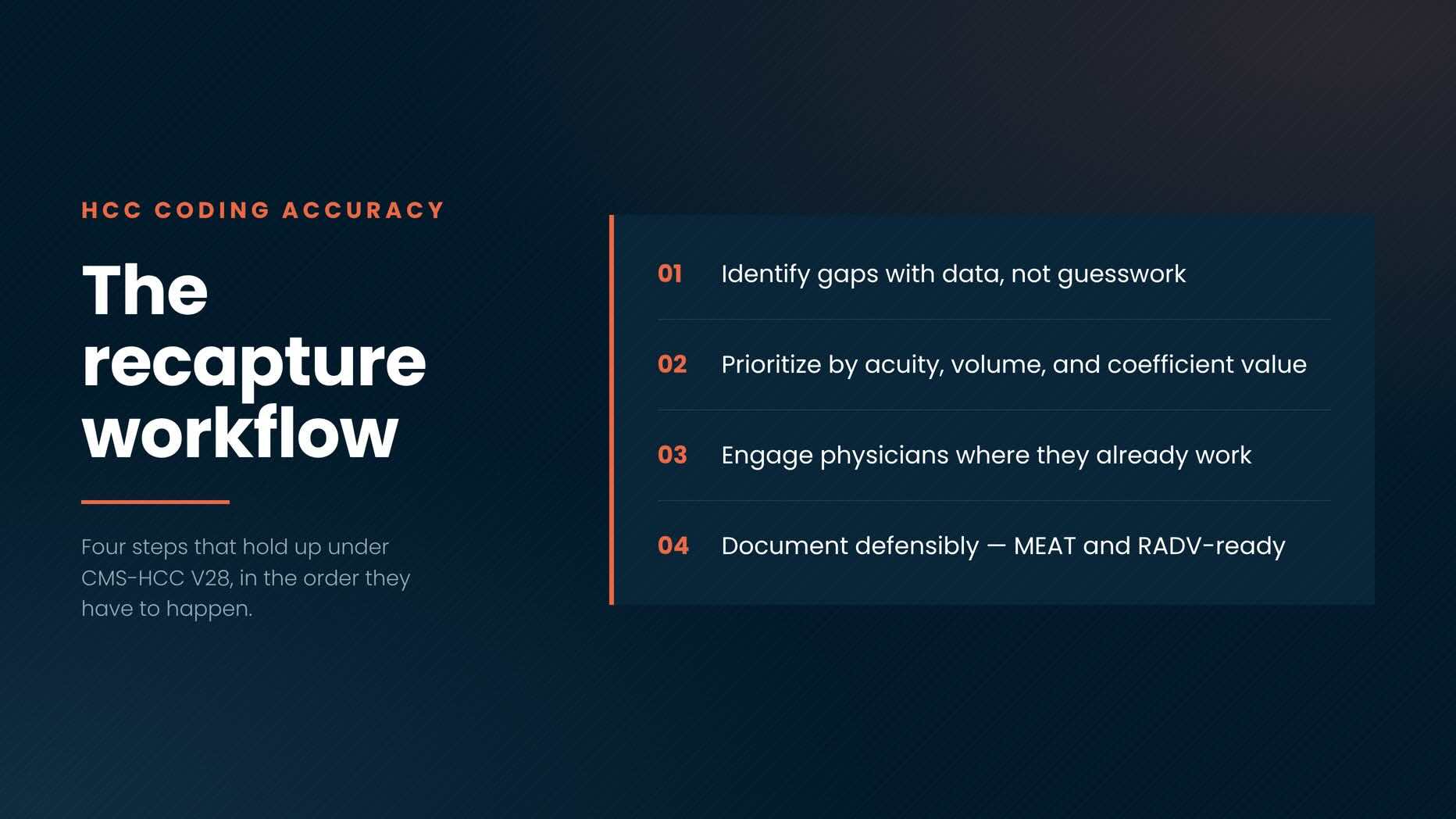
Closing HCC gaps isn’t a single initiative — it’s an operating rhythm. The following four steps reflect how ACOs using population health analytics platforms structure recapture under V28.
Step 1 — Identify gaps with data, not guesswork
Separate the population into patients who’ve had a qualifying visit this year and patients who haven’t. For patients with visits, analytics can flag which prior-year HCCs haven’t been re-coded. For patients without a visit, the priority is closing that access gap before the calendar year ends — those are gaps you cannot code your way out of without an encounter. Suspected-condition analytics, as described above, run alongside both.
Step 2 — Prioritize by acuity, volume, and current coefficient value
Not every gap carries equal weight, and under V28 the weights moved. This is the highest-leverage decision in a resource-constrained program, and it has to be made against the current model rather than institutional memory from V24.
The clearest example is diabetes. Under V24, diabetes with chronic or acute complications carried a coefficient of 0.302 while uncomplicated diabetes carried 0.105 — a real financial reason to chase complication documentation. Under V28, CMS “constrained” the diabetes HCCs: all diabetes HCCs except pancreas transplant status now carry the same 0.166 coefficient, regardless of complications. Congestive heart failure is constrained the same way. An ACO still running a V24-era playbook that prioritizes diabetes complication capture is spending provider attention on a coefficient that no longer differentiates.
Where differentiation does remain, it can be substantial. In the heart disease group, which expanded from five HCCs to ten, end-stage heart failure carries a higher payment than the other heart failure categories. Stable angina and coronary atherosclerosis became non-payment. Severe persistent asthma became a payment HCC for the first time.
AAFP illustrates how much these distinctions compound with a worked example: a patient aged 70–74 with diabetes and peripheral artery disease, malnutrition, atrial fibrillation, toe amputation status, and heart failure with reduced ejection fraction scored a RAF of 2.446 under V24 and 1.014 under V28 — a roughly 59% drop for an identical patient, driven almost entirely by which conditions were reweighted or removed.
That is the case for narrowing focus rather than working every gap equally. One Koan Health client narrowed its entire V28 recapture strategy to two condition families — obesity and heart arrhythmia — because those categories offered the best return on a limited number of provider touchpoints. Koan Health Datalyst™ prioritizes gaps by estimated benchmark impact, adding a dollar-based lens alongside gap count and RAF so an ACO can focus limited resources on the opportunities with the greatest potential financial significance.
Step 3 — Engage physicians where they already work
Recapture programs succeed or fail on physician engagement. The tactics that consistently work: pre-visit reports that flag potential HCC gaps before the appointment, gap alerts embedded directly in the electronic medical record (EMR) rather than in a separate portal, and the ability for providers to dismiss a suspected gap themselves when it isn’t clinically active. Provider scorecards showing recapture performance by physician, practice, and program create accountability — and when tied to shared savings distributions or bonus structures, measurable behavior change.
Step 4 — Document defensibly (MEAT and RADV-ready)
Every gap closed needs to survive scrutiny, not just get recorded. That means documentation showing the condition was actively monitored, evaluated, assessed, or treated during the encounter — not referenced from a problem list — with a legible, credentialed signature. With CMS now auditing every eligible MA contract annually and expanding record sampling, coding for volume without documentation discipline creates exposure rather than revenue.
Annual Wellness Visits: Recapture and Quality Gaps in One Appointment
The Annual Wellness Visit (AWV) is the best-structured opportunity to close HCC gaps, because it’s a guaranteed annual touchpoint built around reviewing a patient’s full health history. AAFP explicitly recommends including codes for complications and secondary diagnoses “especially during annual wellness visits” as a core risk-capture strategy.
The evidence that AWV programs move recapture is direct. In a three-year quality improvement initiative across 89 primary care practices in an Ohio-based ACO, published in the Journal of General Internal Medicine, AWV completion rose from 23.7% in 2018 to 34.9% in 2019 and 59.8% in 2020. HCC completion — defined as documented reassessment of all prior-year HCC conditions — rose from 75.9% in 2019 to 79.7% in 2020.
The payoff extends well past HCC recapture. AAFP frames RN-led annual wellness co-visits as a way to help practices “improve preventive care and their quality metrics” — the same visit that captures conditions also closes quality gaps. Peer-reviewed evidence supports the association: in a study of 630 patients in a family medicine practice comparing AWV attendees to patients seen at standard appointments, every preventive service examined — seven for women and five for men — was used more often by the AWV group, with all odds ratios at or above 1.64 and all p-values at or below .004.
Client data puts a number on the same relationship, measured directly rather than inferred. Across one regional ACO’s three Medicare populations in measurement year 2025 — MSSP, Aetna Medicare Advantage, and UnitedHealthcare Medicare Advantage, roughly 50,500 members — patients who completed an AWV or physical exam closed HCC documentation gaps at a 3 to 5 percentage point higher rate than those who did not. The pattern held in all three programs: 85% versus 82% in MSSP, 87% versus 82% in Aetna MA, and 90% versus 85% in UHC MA had zero open gaps at year-end.
The same members also showed an 11–12% average weighted improvement across quality measures, and one further finding is worth the attention of anyone building an outreach cadence: members with an AWV every year ran roughly 30% lower medical cost than members with no AWV, and about 4% lower than members who completed one only in the current year. Sustained annual engagement outperformed one-time engagement — which is the same logic the CMS-HCC model itself runs on.
For an ACO measured on both risk accuracy and quality performance, that dual yield is the argument for treating the AWV as an operational priority rather than a preventive-care checkbox: generate pre-visit assessment reports flagging suspected HCC gaps and open quality measures together, track year-to-date AWV completion against a target, and distribute eligible-patient lists to providers on a monthly or quarterly cadence so outreach happens before the visit.
(Note: the 630-patient preventive services study was published in 2020. It is cited here because it remains among the few controlled comparisons of AWV versus standard-appointment preventive service use that is not authored by a commercial population health vendor.)
Provider Incentive Structures That Move Recapture Rates
Recapture rates move when incentives are specific, transparent, and tied to something providers can act on. Structures ACOs report success with include performance-based bonuses tied to documented recapture accuracy rather than raw volume, shared savings distributions contingent on meeting recapture benchmarks, and continuing education or certification incentives for coding training.
One structural detail matters more than it seems: calculating a physician’s recapture rate based on whether they were the rendering provider for the original HCC — rather than assigning every gap in their panel to them — reduces pushback and improves buy-in.
What Accurate HCC Coding Is Worth: Real ACO Outcomes
The financial stakes are not abstract. In performance year 202475% of the 476 ACOs in the MSSP earned performance payments totaling $4.1 billion, with Medicare saving $2.5 billion relative to benchmarks — the highest share of ACOs receiving payments since the program began. Net per-capita savings averaged $245, up from $207 in PY2023. Those outcomes are shaped directly by how accurately each ACO’s risk scores reflected its population’s true acuity.
Capture and recapture are different goals — set a target for each
Most programs report one number, the recapture rate, and treat it as the scoreboard. It measures one thing well and two things not at all. Recapture asks whether a condition documented last year was documented again this year, which means it can only be calculated for members who were attributed, seen, and coded last year. Every member outside that set is invisible to it — and unlike the quality measures an ACO is scored on, recapture is not a CMS-published metric, so there is no national benchmark that defines what “good” looks like.
Three rates give a complete picture, and each one points at a different operational fix:
Recapture rate. Of the conditions documented for a member last year, how many were re-documented this year. This is the rate most platforms report, and it measures documentation discipline among already-engaged patients. A weak number here is usually a provider-workflow problem — gap data isn’t reaching the exam room, or it arrives after the visit.
Capture rate for existing members with no prior-year visit. Members attributed for a year or more who had no qualifying encounter last year carry no prior-year coded conditions, so they never enter a recapture denominator at all. Their conditions are real; the documentation isn’t. A weak number here is an access and outreach problem rather than a coding problem.
Capture rate for new members. Newly attributed members arrive with no documented history in your data; you must mine historical claims data provided by the payer within your population health analytics. A weak number here is an onboarding problem — how quickly a new member reaches a first comprehensive visit.
Setting a goal for each rate separates three failures that a single recapture number hides, and it changes where a program spends its next dollar. It also explains why the AWV cadence described above carries more weight than its recapture contribution alone suggests: the visit is the intervention that closes both capture populations, not just the recapture one.
Recapture performance varies widely by EMR capability, practice size, and how consistently gap data reaches providers before the visit — enough that some ACOs deliberately decline to hold every site to a single benchmark.
On the client side: a regional ACO managing 200,000 lives across Commercial, Medicare Advantage, and MSSP programs saw its HCC recapture rate decline roughly 10% during the V24-to-V28 transition. Using the Koan Health Datalyst™ population health analytics platform, the ACO gained early visibility into V28-specific gaps — ahead of when that data was available in its EMR — and focused its response on two high-impact condition families. The result: a 12%+ improvement in HCC recapture rate and a 2.5% increase in average HCC risk score, recovering from the decline and exceeding prior performance.
.svg)