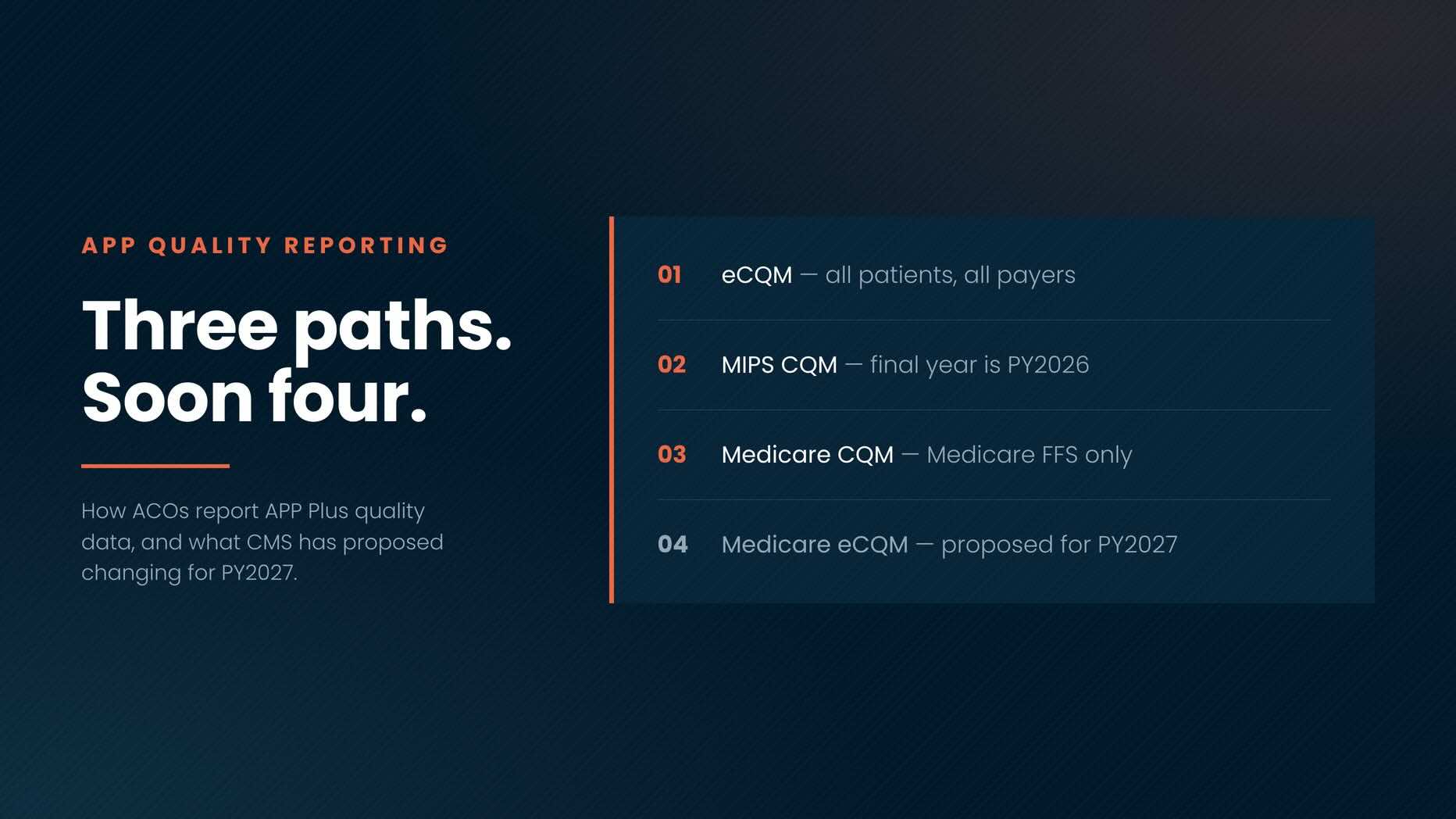


A CMS Qualified Registry is a Centers for Medicare & Medicaid Services (CMS)-approved organization authorized to collect clinical quality data from Accountable Care Organizations (ACOs) and submit it to CMS on their behalf. Every ACO in the Medicare Shared Savings Program (MSSP) must report quality data under the Alternative Payment Model (APM) Performance Pathway (APP) using one of three collection types — electronic Clinical Quality Measures (eCQMs), Merit-based Incentive Payment System (MIPS) Clinical Quality Measures (CQMs), or Medicare CQMs.
One point is worth correcting up front, because it is widely misstated: CMS does not require ACOs to use a Qualified Registry. In its reporting guidance, CMS states plainly that ACOs can submit eCQMs, MIPS CQMs and Medicare CQMs directly. The Quality Payment Program (QPP) maintains lists of Qualified Registries and Qualified Clinical Data Registries for ACOs that choose to use a third-party intermediary. An ACO may aggregate and submit its own data. The real question is not whether CMS forces you to use a registry — it’s whether your ACO has the data infrastructure to aggregate, deduplicate, and certify a submission across every participant practice without one.
This article explains what a Qualified Registry actually does, how the three collection types compare, what changed under APP Plus, and what to evaluate in a partner — including where Koan Health’s certifications fit.
What a Qualified Registry Does — and What It Doesn’t
A Qualified Registry is a CMS-approved third-party intermediary that collects quality, improvement activity, and Promoting Interoperability data and submits it to CMS for MIPS and APP reporting. It’s a distinct designation from a Qualified Clinical Data Registry (QCDR) — QCDRs can also submit custom, non-MIPS measures, while Qualified Registries are scoped to standard MIPS and APP measures.
What the designation covers is narrower than most vendor marketing implies. Qualified Registry status authorizes submission to CMS through the Quality Payment Program. It says nothing about a vendor’s ability to handle Medicare Advantage or commercial quality reporting — those run on different measure sets and different validation standards, which is why NCQA HEDIS® compliance and NCQA Data Aggregator Validation are separate credentials that matter for a different part of an ACO’s book.
The practical friction shows up elsewhere: a population health analytics platform and a Qualified Registry are not automatically the same vendor. ACOs that split the two responsibilities end up managing data handoffs between systems with no common source of truth — which is exactly where reporting errors originate.
The Three Collection Types, Compared
eCQMs pull patient-level data directly from Certified Electronic Health Record Technology (CEHRT) and require reporting on all patients seen by ACO participating providers across all payers, not just Medicare. This is CMS’s long-term direction, but it depends on every electronic health record (EHR) in the network correctly generating the required files.
MIPS CQMs cover the same all-payer, all-patient population, but allow manual or supplemental abstraction rather than a fully electronic pipeline — more flexibility, more manual effort.
Medicare CQMs narrow the population to Medicare fee-for-service beneficiaries across ACO participant tax identification numbers, which meaningfully reduces reporting volume and is often the more manageable path for ACOs still building data automation.
An ACO can use different collection types for different measures, but cannot combine collection types within a single measure.
What APP Plus Actually Requires
Beginning with performance year (PY) 2025, ACOs report the APP Plus quality measure set; the older APP set is no longer available. APP Plus is being phased in and grows each year, which is the detail most reporting plans get wrong. Per the CY2025 Physician Fee Schedule final rule:
- PY2025 — six measures: four reported as eCQMs, MIPS CQMs, or Medicare CQMs (Diabetes glycemic status, Depression screening and follow-up, Controlling high blood pressure, Breast cancer screening), one administrative claims measure (Hospital-Wide 30-day All-Cause Unplanned Readmission), and the CAHPS for MIPS survey.
- PY2026 — eight measures: five clinician-reported (colorectal cancer screening is added), two administrative claims measures, plus CAHPS.
- PY2027 — nine measures, and PY2028 — eleven measures, at which point the set is fully phased in.
The PY2027 and PY2028 counts above are current finalized policy. CMS has since proposed holding the set at eight measures for PY2027 and subsequent years instead, to give ACOs time to adapt to electronic reporting.
Two deadlines follow from this. Under current finalized policy, PY2026 is the final year MIPS CQMs are available as a collection type; from PY2027 forward, ACOs report eCQMs or Medicare CQMs only. CMS has since proposed extending MIPS CQM availability for PY2027 and subsequent performance years, however, so ACOs should monitor the CY2027 rulemaking before finalizing their reporting transition plans. And CMS has signaled that Medicare CQMs themselves will sunset no sooner than five years out, once Fast Healthcare Interoperability Resources (FHIR) adoption is widespread — making eCQM capability the eventual destination for every ACO.
What CMS Has Proposed for PY2027 — and Why It Matters Now
Everything above reflects finalized policy. On July 16, 2026, CMS published the CY2027 Physician Fee Schedule proposed rule (CMS-1848-P), and four of its Shared Savings Program proposals would change the reporting picture materially. None is final — the comment period runs through September 14, 2026, and the final rule is expected in early November on the usual PFS timeline — but an ACO building a PY2027 reporting plan should know what is on the table.
MIPS CQMs may not sunset after all. CMS proposed extending the availability of the MIPS CQM collection type, and the MIPS CQM reporting incentive, for PY2027 and subsequent performance years. For an ACO partway through a rushed migration off MIPS CQMs, this is the most consequential proposal in the rule.
A fourth collection type: Medicare eCQMs. CMS proposed establishing Medicare eCQMs as a new collection type for ACOs reporting the APP Plus measure set — an eCQM reported on only the ACO’s assigned beneficiaries rather than on its all-payer, all-patient population. That is the combination many ACOs have wanted: eCQM specifications without the volume expansion all-payer scope creates. If finalized, ACOs would choose among four collection types rather than three.
The measure set would hold at eight. Rather than growing to nine measures in PY2027 and eleven in PY2028, CMS proposed keeping the APP Plus set at eight for PY2027 and subsequent years — five reported through eCQMs, MIPS CQMs, Medicare CQMs, or the new Medicare eCQMs, two administrative claims measures, and the CAHPS for MIPS survey — explicitly to give ACOs time to adapt to electronic reporting.
TIN exclusions against a 95% threshold. Beginning with PY2026, CMS proposed allowing an ACO to exclude one or more participant TINs from its quality submission under defined circumstances, so long as the TINs it does report on represent at least 95% of the beneficiaries assigned to the ACO. The 75% data completeness requirement would still apply to the remaining denominator.
CMS also proposed revising the definition of a beneficiary eligible for Medicare CQMs so that the reporting population aligns with the ACO’s assigned population — which, if finalized, removes much of the matching guesswork described in the next section.
The practical takeaway is not to wait. Every one of these proposals either reduces burden or adds optionality, and none of them changes the underlying problem: aggregating, deduplicating, and certifying quality data across every participant practice. Build that capability against finalized policy, and treat the proposals as a reason to keep the transition plan flexible rather than a reason to postpone it.
Why This Has Gotten Harder — Not Easier
The scope of APP reporting expanded faster than many ACOs planned for. According to the Healthcare Financial Management Association, only 16% of eligible MSSP ACOs used eCQMs or CQMs in 2023 — meaning the large majority relied on the CMS Web Interface right up until its retirement.
The volume shift compounds it. Because eCQM and MIPS CQM reporting spans all patients across all payers rather than only Medicare-attributed beneficiaries, reporting populations commonly double or triple. In Koan Health's own APP reporting engagements in 2025, a mid-sized ACO with 60,000 attributed Medicare members ended up reporting on more than 120,000 beneficiaries.
Quarterly data is a cadence, not a deliverable
For ACOs on Medicare CQMs, CMS supplies quarterly lists of beneficiaries eligible for the collection type. Those lists are not a year-end reference document — they are a work queue, and treating them as anything else is the most common way an ACO loses a reporting year.
The reason is arithmetic. Data completeness requires performance data on at least 75% of the eligible, matched denominator population. That population grows each quarter as new beneficiaries become eligible and new encounters land. An ACO that works its Q1 list in Q1 is chasing a defined, finite set of records. An ACO that waits until Q4 is trying to abstract, match, and validate four quarters of accumulated volume against a submission deadline — and there is no mechanism to catch up. Chart abstraction capacity does not scale on demand, and a Q1 list that looked manageable in April can be several times its original size by December.
The operational discipline is unglamorous and decisive: work each quarterly list in the quarter it arrives, reconcile matching gaps while the encounters are recent, and treat year-end as a verification step rather than a production sprint.
Why Certifications Are the Real Differentiator
Because a registry handles data that directly determines shared savings and quality scores, the certifications behind a vendor matter more than the marketing around them.
CMS Qualified Registry status confirms CMS has authorized the vendor to submit MIPS and APP quality data on an ACO’s behalf. This is the credential that applies to CMS submission specifically.
NCQA HEDIS® compliance confirms a vendor’s processes meet the National Committee for Quality Assurance’s standards for the Healthcare Effectiveness Data and Information Set — the measure set used across Medicare Advantage and commercial value-based contracts, not MSSP.
NCQA Data Aggregator Validation (DAV) Partner status is the least understood and most operationally significant. NCQA’s DAV program audits how a vendor ingests, transforms, validates, and outputs clinical data across its entire lifecycle — governance, coding integrity, quality assurance, and security — so a validated data stream can be used as standard supplemental data in HEDIS reporting without separate primary-source verification. In practice, an ACO working with a DAV-certified partner spends less time re-proving its own data to auditors.
Together these three cover different parts of an ACO’s reporting obligations: one for CMS submission, two for the Medicare Advantage and commercial contracts running alongside it.
How Koan Health Qualifies
Koan Health holds all three, built over more than a decade in this space. Koan Health achieved CMS Qualified Registry status and NCQA HEDIS® compliance in 2020, became an NCQA Certified DAV Partner in 2023, and holds HITRUST r2 certification covering data security.
Koan Health’s eCQM and CQM reporting capability is built directly into Koan Health’s Datalyst™ platform rather than licensed from a third-party sub-processor — which means the same source of truth that produces an ACO’s analytics also produces its quality submission, with no handoff between systems.
Choosing a Registry Partner: What to Actually Evaluate
Selecting a partner comes down to concrete questions, not brand familiarity.
Can the vendor support every collection type? An ACO that can only report one way is locked in as requirements shift — and between the MIPS CQM sunset, the proposed Medicare eCQM collection type, and the eventual move to eCQMs, that shift is scheduled rather than hypothetical, even while its exact shape is still in rulemaking.
Is the registry function native to the analytics platform, or bolted on? This is where data accountability gets lost when discrepancies surface. Ask whether quality submission and population analytics run off the same underlying data, or whether the vendor “integrates” a third-party registry.
Does the vendor hold independent data-quality certification? NCQA DAV means an external auditor has validated the data pipeline. Without it, an ACO is taking accuracy on faith.
Does the vendor operate on a quarterly cadence with you? Given how Medicare CQM eligible populations accumulate, a partner that surfaces quarterly lists and works them alongside the ACO is materially different from one that processes whatever arrives at year-end.
Does the vendor have a track record through specific transition points? The PY2026 MIPS CQM sunset — and CMS’s proposal to postpone it — is the immediate one. Ask what the vendor’s transition plan looks like for clients still on that collection type, and how quickly they re-plan when a proposed rule moves a deadline.
Frequently Asked Questions
What is a CMS Qualified Registry?
A CMS Qualified Registry is a CMS-approved organization authorized to collect quality, improvement activity, and Promoting Interoperability data from clinicians and ACOs and submit it to CMS on their behalf for MIPS and APP reporting.
Do ACOs have to use a Qualified Registry for APP reporting?
No. CMS states that ACOs can submit eCQMs, MIPS CQMs, and Medicare CQMs directly, and maintains lists of Qualified Registries and QCDRs for ACOs that choose to use a third-party intermediary. The practical question is whether an ACO can aggregate, deduplicate, and certify a submission across all participant practices on its own.
How many measures are in the APP Plus quality measure set?
APP Plus phases in over several years. PY2025 required six measures: four reported as eCQMs, MIPS CQMs, or Medicare CQMs, one administrative claims measure, and the CAHPS for MIPS survey. PY2026 requires eight, PY2027 nine, and PY2028 eleven once fully phased in. In the CY2027 Physician Fee Schedule proposed rule, CMS proposed holding the set at eight measures for PY2027 and subsequent years rather than continuing that growth. That proposal is not final.
What’s the difference between eCQM, MIPS CQM, and Medicare CQM reporting?
eCQMs and MIPS CQMs both require reporting on all patients across all payers, with eCQMs pulled electronically from certified EHR technology and MIPS CQMs allowing manual or supplemental abstraction. Medicare CQMs narrow the population to Medicare fee-for-service beneficiaries across ACO participant TINs, reducing volume.
What happens to MIPS CQM reporting after 2026?
Under current finalized policy, PY2026 is the last year ACOs can use MIPS CQMs in the APP Plus set, and from PY2027 they report eCQMs or Medicare CQMs only. CMS has proposed extending MIPS CQM availability for PY2027 and subsequent performance years, but that proposal is not final. An ACO still on MIPS CQMs should keep a transition plan in motion and watch the CY2027 rulemaking rather than assuming either outcome.
What is a Medicare eCQM?
A Medicare eCQM is a new collection type CMS proposed in the CY2027 Physician Fee Schedule proposed rule. It would let an ACO report an APP Plus eCQM on only its assigned Medicare beneficiaries rather than on its full all-payer, all-patient population — pairing eCQM specifications with the narrower population scope that makes Medicare CQMs manageable. CMS proposed it for PY2027 and subsequent performance years; it is not final.
Why does quarterly Medicare CQM data need to be worked quarterly?
Data completeness requires performance data on at least 75% of the eligible, matched denominator, and that population accumulates each quarter. An ACO that defers abstraction until year-end faces several quarters of volume at once against a fixed deadline, with no mechanism to catch up.
Why does NCQA Data Aggregator Validation matter for a registry vendor?
DAV certification means an independent NCQA audit has validated how a vendor ingests, transforms, and outputs clinical data across its lifecycle. Validated streams can be used as standard supplemental data in HEDIS reporting without separate primary-source verification, reducing audit burden for the ACO.
Is Koan Health a CMS Qualified Registry?
Yes. Koan Health has held CMS Qualified Registry status since 2020, is NCQA HEDIS® compliant, became an NCQA Certified DAV Partner in 2023, and holds HITRUST r2 certification.
.svg)